

No wines found. Filter by country, varietal, and more on our All Wines page.
Browse All Wines
For anyone venturing beyond a quick glance at the label, wine scores are everywhere. They are powerful numbers—a 95-point endorsement can drive sales, while a lukewarm 82 can doom a vintage. But what do these scores actually mean, and why is there often such a disparity between the ratings given by seasoned professional critics and the scores generated by the burgeoning community of amateur reviewers on platforms like Vivino?
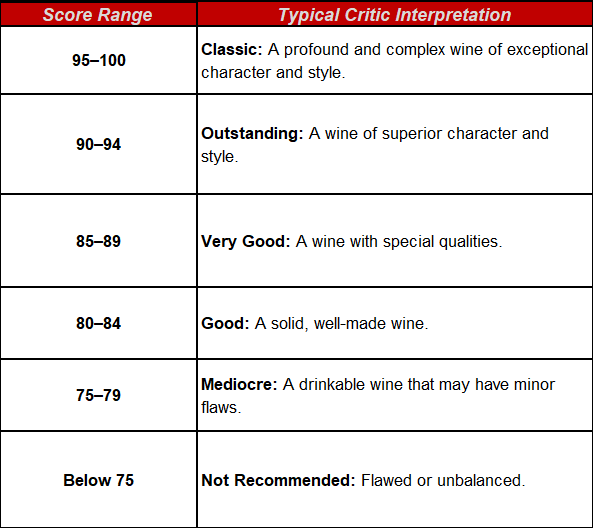
Professional wine critics (like those from Wine Spectator, Robert Parker’s The Wine Advocate, or Jancis Robinson) employ scoring systems designed for consistency, context, and rigorous evaluation. The most common system is the 100-point scale, originally popularized by Robert Parker in the late 1970s, early 1980s.
A professional critic’s score is not simply amatter of personal preference; it is supposed to be an objective analysis benchmarked against established quality standards. They typically consider four core criteria:
● Assessment: Is the color appropriate for the grape and age? Is the wine clear, or cloudy? Is the viscosity (legs) indicative of high alcohol or sugar? (Usually accounts for 5-10 points)
● Assessment: The complexity, intensity, and cleanliness of the scent. Do the aromas reflect the varietal character (e.g., cassis for Cabernet, citrus for Riesling)? Are there any faults (e.g., cork taint, excessive volatile acidity)? (Usually accounts for 15-20 points)
● Assessment: The core evaluation of how the wine tastes. Critics assess balance (the harmony between acidity, tannin, alcohol, and sweetness), intensity, length (how long the flavor lingers—the finish), and complexity. (Usually accounts for 20-30 points)
● Assessment: A holistic view of the wine's potential for improvement with age, its typicity (how well it represents its region and grape), and overall quality relative to its peers. (Usually accounts for 5-10 points)
Apps like Vivino have democratized wine reviewing. With millions of users scanning labels and posting star ratings, they offer an unparalleled volume of data. Vivino's primary strength is accessibility and social proof.
Vivino uses a simple five-star rating system, which is then averaged across all user submissions.
● Assessment: The core driver is personal preference. Did the user enjoy the bottle? If yes, it gets 4 or 5 stars. Ifnot, it gets 3 or fewer.
● Context: These scores are generally assigned without comparison to a global quality standard, regional typicity, or the wine's intrinsic structure. They are immediate, subjective reactions.
● Assessment: The wine's price point, label appeal, and social buzz can influence ratings. A $15 wine that tastes surprisingly good might get 4.5 stars because it exceeded low expectations.
It is common to see a Vivino average of 4.2 stars for a wine that receives an 88 from a professional critic. This inflation happens for several reasons:
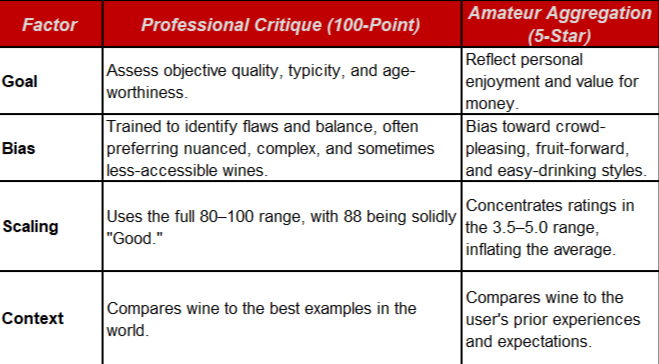
The biggest challenge is translating the 5-star amateur scale to the 100-point professional scale. Amateurs tend to rate much higher because 3 out of 5 stars often feels like a "bad" review, when professionally, an 80-84 point wine (a "Good" score) would translate closer to a 3.5-star average.
A recent Vivino study tried to map Vivino scores to professional critic scores and this is roughly how that translated:
4.6+ Vivino ≈ 95+ Points (Critics): Exceptional wine (top 1% of wine in themarket)
4.4 Vivino ≈ 94 Points (Critics): Outstanding wine (top 5% of wine in themarket)
4.2 Vivino ≈ 92 Points (Critics): Suggests a wine you're unlikely to regret(top 10%)
4.0 Vivino ≈ 90 Points (Critics): Aligns with a solid-to-very-good wine(top 15%)
3.6 - 3.9 Vivino ≈ 88 Points (Critics): A drinkable wine, not a world-beater(top 50%)
Ultimately, professional scores are guides to quality, structure, and cellar potential, offering deep, comparative context. Amateur scores, on the other hand, are invaluable signals for immediate drinkability, widespread appeal, and value—a measure of whether the average consumer enjoyed their purchase. Both have their place, but they speak different languages when it comes to the complex world of wine.
At Occasional Wine, we believe both professional and amateur evaluations are essential. Our entire inventory selection is based on the balance of these two scores.
To ensure quality, everyone of the more than 500 wines we offer must meet two minimum benchmarks: a professional wine critic score of 90 and a Vivino score of 4.0. The only exceptions are very small productions or recent vintages that haven't yet been scored. In those limited cases, we only carry the wine if prior vintages or productions have met both of these scoring benchmarks.
Want to learn more about Wine? You've come to the right place, check out the Occasional Wine blog to stay updated on the latest articles and posting from Occasional Wine. Cheers!
